
Difference Between Residential and Agricultural Land: Top 7
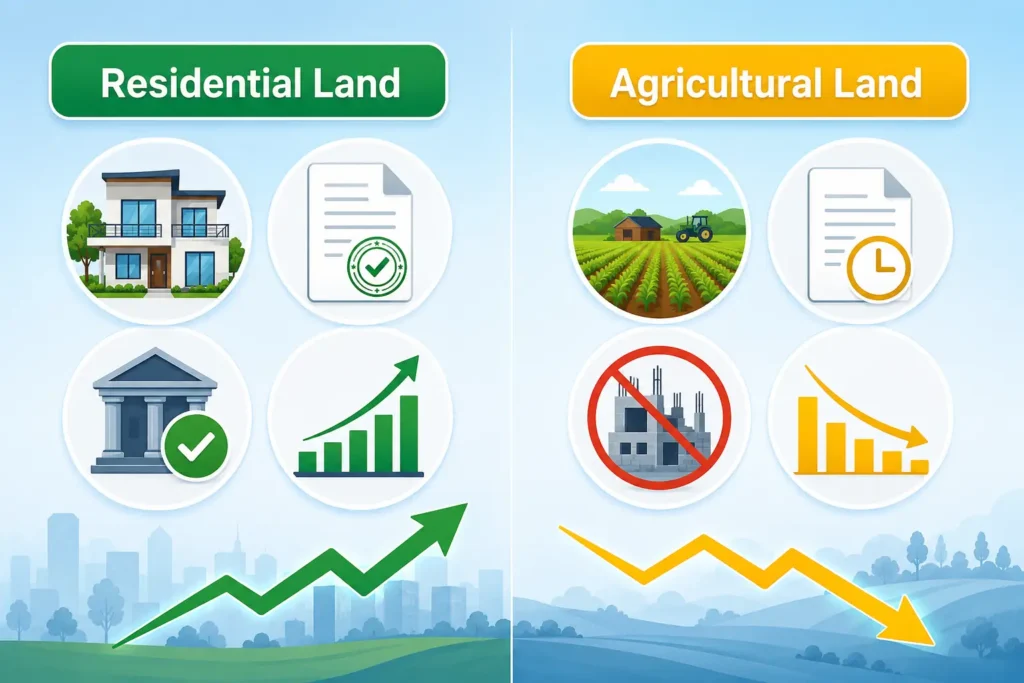
Every property buyer must understand the Difference Between Residential and Agricultural Land before making a purchase. Many people buy agricultural land hoping to build a home later, only to discover that the law does not permit residential construction without proper conversion. If you are planning to buy land in India, knowing the Difference Between Residential and Agricultural Land is not just helpful — it is absolutely essential. A wrong decision can lead to legal trouble, financial loss, and wasted years of effort. According to the Ministry of Housing and Urban Affairs, understanding land classification is the foundation of safe property transactions.
This complete guide explains the Difference Between Residential and Agricultural Land in simple terms so you can make a confident choice. We cover everything from legal classification to conversion laws, taxation, loans, and resale value. Whether you are a first-time buyer or an experienced investor, this guide will help you avoid costly mistakes.
What Is Residential Land?
Residential land is land that has been approved by local municipal or planning authorities for construction of homes, apartments, or other dwelling units. It is classified under non-agricultural use in government records. When you buy residential land, you get the legal right to build a home on it without needing any special permissions. This is the first and most important factor in the Difference Between Residential and Agricultural Land.
Key characteristics of residential land include approval from authorities like BMRDA, BDA, or BBMP. It comes with an A Khata certificate in most cases, which makes it fully legal for construction. Property tax is applicable and paid to the municipal corporation. You can use it for building a home, villa, or apartment complex. Residential land is eligible for home loans from banks, which means you can finance up to 80 to 90 percent of the purchase price. It has a higher resale value compared to agricultural land because of its legal clarity and development potential. Infrastructure like roads, water supply, electricity, and drainage are typically available in residential layouts.
When you understand the Difference Between Residential and Agricultural Land, you will see that residential land offers convenience, legal safety, and peace of mind. It is the preferred choice for anyone who wants to build a home without dealing with complex legal processes.
What Is Agricultural Land?
Agricultural land is land that is used for farming, cultivation, horticulture, or plantation activities. It is classified under agricultural use in government revenue records. This classification comes with specific restrictions that are important to understand as part of the Difference Between Residential and Agricultural Land.
Key characteristics of agricultural land include its use for farming and cultivation. The purchase price is significantly lower compared to residential land in the same area — often 30 to 50 percent cheaper. Agricultural tax is applicable at much lower rates than property tax for residential land. However, agricultural land cannot be used for construction of a home without undergoing a legal conversion process. It is not eligible for home loans from banks. Only agricultural loans are available, and they are based on farming potential rather than land value. The resale value is lower in most cases because the buyer pool is limited. Some states in India also restrict who can buy agricultural land, requiring the buyer to be a farmer.
Understanding this side of the Difference Between Residential and Agricultural Land helps you realize that agricultural land is cheaper for a reason. The lower price comes with significant legal and usage restrictions that can complicate your plans if you intend to build a home.
Top 7 Key Differences Between Residential and Agricultural Land
Here are the 7 most important points of Difference Between Residential and Agricultural Land that every buyer should know before making a decision:
Approved Use — Residential land is legally approved for building homes. Agricultural land is meant for farming.
Legal Status — Residential land comes with A Khata certificate. Agricultural land requires conversion.
Construction — Construction is directly allowed on residential land. It is restricted on agricultural land.
Loans — Home loans are easily available for residential land. Only agricultural loans for farming land.
Resale Value — Residential land appreciates at 8 to 15% per year. Agricultural land at only 3 to 6% per year.
Price — Residential land costs more but offers legal clarity. Agricultural land is cheaper with restrictions.
Tax — Property tax applies to residential land at higher rates. Agricultural tax at lower rates.
Each of these 7 points in the Difference Between Residential and Agricultural Land affects your buying decision differently.
Understanding the Legal Classification
One of the most fundamental aspects of the Difference Between Residential and Agricultural Land is their legal classification. Residential land is recorded as non-agricultural land in government revenue records. Agricultural land is recorded as land used for farming and agricultural purposes.
Why does this matter? Because each classification follows a different set of laws and regulations. Residential land falls under municipal authorities and town planning departments. Agricultural land falls under the revenue department and agriculture department. The paperwork required to buy each type is also different. Agricultural land transactions often require additional clearances and approvals.
The National Housing Bank recommends that every buyer verify the legal classification of any land before making a purchase. This is a critical step in understanding the Difference Between Residential and Agricultural Land and avoiding legal disputes later.
Legal disputes are far more common with agricultural land because of conversion issues, ownership disputes, and unauthorized construction. Residential land with clear A Khata documentation has a much cleaner legal history and is safer to buy.
Conversion Laws: A Critical Difference
One of the most important practical aspects of the Difference Between Residential and Agricultural Land is the conversion process. If you buy agricultural land and want to build a home, you must first convert it to residential land through a legal process. This conversion is not automatic and can take a significant amount of time.
The conversion process involves several steps. First, you must obtain the land records and verify the current classification. Then, you file a conversion application with the Deputy Commissioner or relevant authority. You submit all required documents along with the application. You pay the applicable conversion fee and any penalty that may be charged. After that, government officials inspect the land to verify its condition. Once approved, you receive a conversion order. Finally, you update the revenue records to reflect the new classification.
This entire process can take anywhere from 6 months to 2 years depending on the state, location, and complexity of the case. Many buyers overlook this aspect of the Difference Between Residential and Agricultural Land and end up facing serious legal trouble. Some have even faced demolition notices for building without proper conversion.
Understanding this critical Difference Between Residential and Agricultural Land will save you from years of legal headaches and financial losses.
Usage Restrictions
Another significant aspect of the Difference Between Residential and Agricultural Land is the restrictions on usage. Residential land gives you the freedom to build your home exactly as you wish, subject to local building bylaws. Agricultural land comes with strict usage restrictions that limit what you can do.
What is restricted on agricultural land without conversion? Building permanent residential structures is not allowed. You cannot construct compound walls or fencing without permission. Setting up commercial establishments is prohibited. Dividing the land into smaller residential plots for sale is not permitted. You cannot advertise or sell the land as residential property.
If you buy agricultural land with the intention of building a home later, you must be prepared for these restrictions. This Difference Between Residential and Agricultural Land is the reason why many buyers who purchase agricultural land on a budget end up regretting their decision later.
Taxation Differences
Taxation is another practical aspect of the Difference Between Residential and Agricultural Land that affects your annual expenses. Residential land requires you to pay property tax to the municipal corporation every year. The tax rate is based on the property value and area, and it is typically higher than agricultural tax.
Agricultural land requires you to pay agricultural tax to the revenue department. The rates are much lower, and some states even offer tax exemptions for agricultural land. However, once you convert agricultural land to residential use, you must start paying property tax at the higher rate.
This financial aspect of the Difference Between Residential and Agricultural Land should be factored into your long-term budget.
Loans and Banking
When it comes to financing, the Difference Between Residential and Agricultural Land is significant and affects your ability to purchase. Residential land is eligible for home loans and plot purchase loans from all major banks. You can get up to 80 to 90 percent of the property value as a loan, with repayment tenure of up to 20 to 30 years. The interest rates are competitive, and the approval process is straightforward.
Agricultural land, on the other hand, is not eligible for home loans. Banks only offer agricultural loans for farming land, and these loans are based on the farming potential of the land rather than its market value. The loan amount is typically lower, the terms are different, and you may need to provide proof of farming activity.
If you need a loan to buy land, this Difference Between Residential and Agricultural Land will directly impact your ability to purchase.
Resale Value and Appreciation
The Difference Between Residential and Agricultural Land in terms of resale value is substantial and affects your long-term investment returns. Residential land typically appreciates at a rate of 8 to 15 percent per year, depending on the location and market conditions. It is easy to find buyers because there is high demand for residential plots. The legal clarity and A Khata documentation make the transaction smooth and hassle-free.
Agricultural land appreciates at a much lower rate of 3 to 6 percent per year. The buyer pool is limited because only farmers or those willing to go through the conversion process are interested. Banks do not provide home loans for agricultural land, which further reduces the number of potential buyers.
This Difference Between Residential and Agricultural Land in resale value means that residential land is a better investment for most buyers.
Can You Build a Home on Agricultural Land?
This is the most common question buyers ask. The direct answer is no — you cannot build a home on agricultural land without first converting it to residential land through the legal process.
What happens if you build without conversion? The local municipal authority can issue a demolition notice and take legal action. You cannot obtain a building permit or occupancy certificate. Banks will not provide loans for construction. You cannot register the property as a residential home. In some cases, the government can even seize the property.
Building without proper conversion is one of the most serious violations of the Difference Between Residential and Agricultural Land.
Which One Should You Choose?
Choose residential land if you want to build a home within 1 to 2 years, need a home loan, prefer clear A Khata documentation, want higher resale value, and want easy access to infrastructure.
Choose agricultural land only if you plan to use it for farming, you have a lower budget with patience for long-term returns, you are willing to handle the conversion process, and you accept the legal complexities.
For 90 percent of first-time buyers, residential land is the better choice.
Frequently Asked Questions:
Q: What is the main difference between residential and agricultural land?
A: Residential land is approved for building homes with A Khata. Agricultural land is meant for farming and requires conversion before any construction.
Q: Can I build a house on agricultural land?
A: No. You must first convert it to residential land through the legal process. Building without conversion is illegal.
Q: Which has better resale value?
A: Residential land appreciates at 8 to 15 percent yearly compared to 3 to 6 percent for agricultural land.
Q: Can I get a home loan for agricultural land?
A: No. Only agricultural loans are available for farming land.
Q: Is agricultural land cheaper?
A: Yes, typically 30 to 50 percent cheaper, but comes with significant legal restrictions.
Q: How long does conversion take?
A: 6 months to 2 years depending on the state and location.
Q: Which is better for first-time buyers?
A: Residential land is safer, easier to finance, and simpler to develop.
Quick Recap:
Residential land is for homes; agricultural land is for farming
Residential land has A Khata; agricultural land needs conversion
Construction allowed on residential land; restricted on agricultural land
Home loans for residential land; agricultural loans for farming land
Higher resale value for residential land; lower for agricultural land
Higher price for residential land; lower for agricultural land
Property tax for residential; agricultural tax for farming land
Final Thoughts:
Understanding the Difference Between Residential and Agricultural Land is the first and most important step before buying any property in India. This knowledge protects you from legal trouble, financial loss, and years of regret.
If your goal is to build a home for your family, residential land is always the safer and smarter choice. If you are considering agricultural land, make sure you fully understand the conversion process and legal implications before making any payment.
At Sapthagiri Promoters and Developers, we offer only BMRDA-approved residential plots with clear A-Khata documentation. Every layout is fully approved, legally clear, and ready for you to build your dream home. We also provide a complimentary doorstep cab facility so you can visit our plots without any hassle.
Know the Difference Between Residential and Agricultural Land. Choose wisely. Your dream home depends on it.
Contact Sapthagiri Promoters and Developers
Phone: 9900004189 / 9900001104
Website: https://sapthagiripromoters.com
Sapthagiri Promoters and Developers — Your Trusted Real Estate Partner