
Stamp Duty & Registration Charges Explained – The Complete Guide (2026)
Stamp Duty & Registration Charges Explained — your complete guide to property costs in Nelamangala and Karnataka.
Stamp Duty & Registration Charges Explained is the essential knowledge every property buyer needs before finalizing a land purchase. Buying a plot involves more than just the property price, and understanding these additional costs can save you from unexpected financial surprises. In this detailed guide, we will break down every fee, every calculation method, and every way to minimize your registration expenses legally.
Stamp Duty & Registration Charges Explained: Why These Costs Matter
Stamp Duty & Registration Charges Explained is not just about knowing the rates — it is about understanding why these charges exist and how they affect your total investment. Many buyers focus only on the property price and forget that registration costs can add 6-7% to the total amount.
In Karnataka, property registration charges consist of two main components: stamp duty and registration fees. Additionally, there are surcharges and cess that increase the total cost. Failing to account for these charges during your budgeting phase can lead to last-minute financial stress.
This guide covers everything about Stamp Duty & Registration Charges Explained in Karnataka, so you can plan your investment accurately and avoid surprises at the sub-registrar's office.
Stamp Duty & Registration Charges Explained: Complete Rate Structure
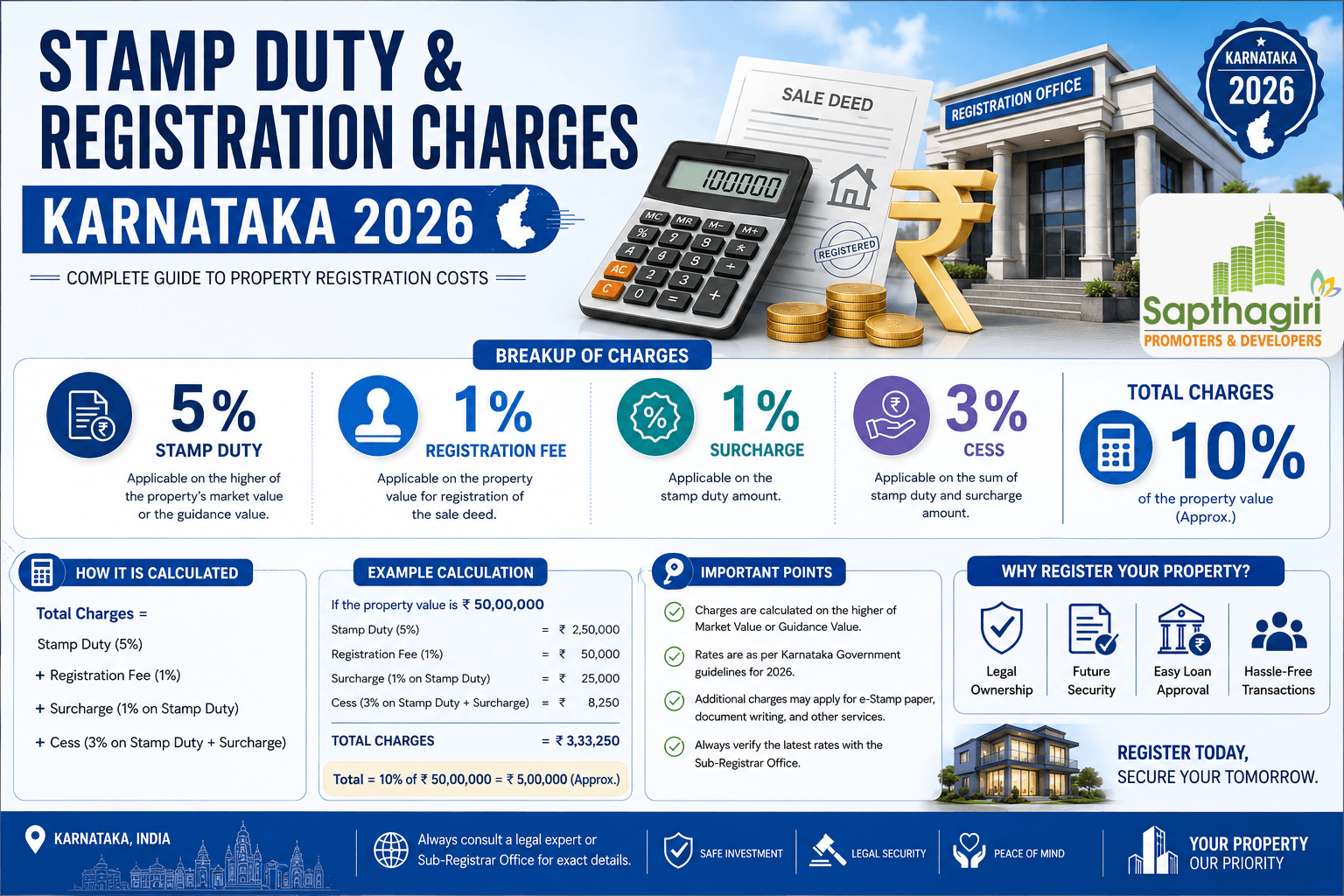
Below is the complete breakdown of charges you need to pay during property registration in Karnataka:
| Component | Rate | Applies To |
|---|---|---|
| Stamp Duty | 5% of market value | All properties in Karnataka |
| Registration Fee | 1% of market value | All properties in Karnataka |
| Surcharge | 1% of market value | Properties above ₹20 lakhs |
| Cess | 3% of stamp duty | All registered properties |
| BBMP Cess (Bengaluru only) | Additional varying rate | BBMP jurisdiction properties |
Understanding this rate structure is the first step in comprehending Stamp Duty & Registration Charges Explained in Karnataka.
Stamp Duty & Registration Charges Explained: Calculation Examples
Let us walk through real examples to make Stamp Duty & Registration Charges Explained crystal clear.
Stamp Duty & Registration Charges for Plot Worth ₹30 Lakhs
| Component | Calculation | Amount |
|---|---|---|
| Stamp Duty | 5% of ₹30,00,000 | ₹1,50,000 |
| Registration Fee | 1% of ₹30,00,000 | ₹30,000 |
| Surcharge | 1% of ₹30,00,000 | ₹30,000 |
| Cess | 3% of ₹1,50,000 | ₹4,500 |
| Total Payable | ₹2,14,500 |
Stamp Duty & Registration Charges for Plot Worth ₹50 Lakhs
| Component | Calculation | Amount |
|---|---|---|
| Stamp Duty | 5% of ₹50,00,000 | ₹2,50,000 |
| Registration Fee | 1% of ₹50,00,000 | ₹50,000 |
| Surcharge | 1% of ₹50,00,000 | ₹50,000 |
| Cess | 3% of ₹2,50,000 | ₹7,500 |
| Total Payable | ₹3,57,500 |
These examples show exactly how Stamp Duty & Registration Charges Explained translate into real numbers for your property purchase.
Stamp Duty & Registration Charges Explained: Urban vs Rural Rates
One important aspect of Stamp Duty & Registration Charges Explained is understanding whether urban or rural rates apply to your property.
| Area Type | Stamp Duty | Registration Fee |
|---|---|---|
| Urban Areas (City Limits) | 5% | 1% |
| Rural Areas (Outside City Limits) | 5% | 1% |
| Bengaluru (BBMP Area) | 5% + Additional Cess | 1% |
| Nelamangala (TMC Area) | 5% | 1% |
In Karnataka, the base stamp duty rate remains the same at 5% for both urban and rural areas. However, additional cess and surcharges may vary based on the local governing body.
Stamp Duty & Registration Charges Explained: Factors Affecting Total Cost
Several factors influence the total registration charges you pay. Understanding these factors is essential for accurate Stamp Duty & Registration Charges Explained.
- Property Value: The higher the market value, the higher the absolute amount of stamp duty and registration fees
- Location: Properties in Bengaluru may have additional cess compared to Nelamangala or other rural areas
- Property Type: Residential plots, commercial properties, and agricultural land may have different rate structures
- Market Value vs Guideline Value: Stamp duty is calculated on the higher of the two values
- Joint Registration: If multiple buyers are involved, the registration process remains the same but documentation requirements increase
These factors directly impact your Stamp Duty & Registration Charges Explained calculations and total investment budget.
Stamp Duty & Registration Charges Explained: Payment Methods
Understanding how to pay is as important as understanding how much to pay. Stamp Duty & Registration Charges Explained includes knowing the available payment methods.
- E-Challan: Pay directly at the sub-registrar's office through e-challan system
- Demand Draft: Prepare a demand draft in favor of the Sub-Registrar
- Online Payment: Use the Karnataka government's online payment portal for stamp duty
- E-Stamping: Purchase e-stamp paper through authorized centers or online
Online payment options have made paying Stamp Duty & Registration Charges Explained more convenient and transparent.
Stamp Duty & Registration Charges Explained: 5 Ways to Save Money Legally
Every buyer wants to minimize registration costs. Here are five legal ways to reduce your Stamp Duty & Registration Charges Explained:
- Tip #1: Register Early to Avoid Penalties
- The registration must be completed within four months of executing the sale deed. Late registration attracts penalties up to 10 times the registration fee. Complete the process on time to avoid unnecessary additional costs.
- Tip #2: Use Guideline Value Strategically
- Stamp duty is calculated on the higher of market value or guideline value. If the guideline value is lower than your negotiated price, you benefit from lower stamp duty charges.
- Tip #3: Consider Joint Ownership
- Joint ownership with a family member can help distribute the registration burden. However, ensure all co-owners are present during registration and have valid documents.
- Tip #4: Buy During Government Schemes
- Occasionally, the Karnataka government announces reduced stamp duty rates or registration fee waivers to boost property transactions. Stay updated on such announcements to save on registration charges.
- Tip #5: Choose Properties with Clear Documentation
- Properties with complete documentation, BMRDA approval, and clear titles face fewer complications during registration. This avoids delays, repeated visits, and potential penalty situations.
Following these tips while understanding Stamp Duty & Registration Charges Explained will help you save significantly on your property purchase.
Stamp Duty & Registration Charges Explained: Common Mistakes to Avoid
Even with Stamp Duty & Registration Charges Explained clearly, buyers often make preventable errors that cost them money.
- Mistake #1: Budgeting Only for Property Price
- Many buyers forget to include registration charges in their budget. Always add 6-7% to the property price to account for stamp duty, registration fees, surcharges, and cess.
- Mistake #2: Underestimating Property Value
- Paying stamp duty based on an underestimated property value is illegal. The sub-registrar's office verifies the guideline value, and if your declared value is lower, you may face penalties.
- Mistake #3: Skipping Professional Guidance
- While you can handle registration independently, a property lawyer or experienced promoter can ensure all calculations are accurate and no hidden charges are missed.
- Mistake #4: Not Verifying Final Amount
- Always verify the total amount calculated by the sub-registrar's office before making payment. Cross-check with your own calculations based on the rate structure explained above.
Avoiding these mistakes while understanding Stamp Duty & Registration Charges Explained will protect your investment and prevent financial surprises.
Stamp Duty & Registration Charges Explained: Benefits of Proper Knowledge
Understanding Stamp Duty & Registration Charges Explained before purchasing a property offers several advantages:
- Accurate Budgeting: Plan your total investment without unexpected financial gaps
- Negotiation Power: Understand the true cost and negotiate better with sellers
- Faster Registration: Have all funds ready for smooth and quick registration process
- Legal Compliance: Ensure you pay the correct amounts and avoid penalties
- Investment Planning: Calculate actual returns considering all costs involved
Proper knowledge of Stamp Duty & Registration Charges Explained is your foundation for a successful property investment in Karnataka.
Stamp Duty & Registration Charges Explained: Trust Sapthagiri Promoters
When you choose Sapthagiri Promoters & Developers for your property purchase in Nelamangala, you get complete transparency on all registration charges.
Every plot listed by Sapthagiri Promoters comes with clear documentation that includes the exact property value, applicable stamp duty, and registration fees. Our team has established relationships with the Nelamangala Town Municipal Council, BMRDA, and the local Sub-Registrar's office.
Our layouts are situated near NH48 and key infrastructure corridors in Nelamangala. Each layout carries proper BMRDA approval, A Khata certification, and complete title documentation. We also assist buyers with accurate cost calculations and registration support.
"Our promise is simple: transparent pricing, accurate cost calculations, and zero hidden charges. That is the Sapthagiri difference in Stamp Duty & Registration Charges Explained."
Stamp Duty & Registration Charges Explained: Frequently Asked Questions
What is the current stamp duty rate for property registration in Karnataka?
The current stamp duty rate is 5% of the property's market value. Additionally, a 1% surcharge applies to properties valued above ₹20 lakhs, and a 3% cess is levied on the total stamp duty amount.
How much is the registration fee according to Stamp Duty & Registration Charges Explained?
The registration fee in Karnataka is 1% of the property's market value, with a minimum and maximum cap as per government regulations. This fee is payable at the time of registration at the sub-registrar's office.
Are stamp duty rates different for urban and rural areas in Karnataka?
In Karnataka, the base stamp duty rate is 5% for both urban and rural areas. However, additional cess and surcharges may vary based on the local governing body, such as BBMP for Bengaluru or TMC for Nelamangala.
Can I pay stamp duty online as per Stamp Duty & Registration Charges Explained?
Yes. Karnataka offers online payment options for stamp duty through the government's e-stamping portal. You can also use e-challan at the sub-registrar's office or purchase e-stamp paper from authorized centers.
What happens if I underestimate the property value for stamp duty calculation?
Underestimating the property value is illegal. The sub-registrar's office verifies the guideline value, and if your declared value is significantly lower, you may face penalties, registration rejection, or legal consequences.
Does Sapthagiri Promoters help with Stamp Duty & Registration Charges Explained calculations?
Yes. Every project from Sapthagiri Promoters includes complete documentation and transparent cost breakdowns. Our team provides accurate stamp duty and registration fee calculations upfront. Visit sapthagiripromoters.com or call +91-9900001104 for detailed cost information.
Get Accurate Stamp Duty & Registration Charges for Your Plot Today
Explore our verified residential plots in Nelamangala with transparent pricing and accurate registration cost calculations. Clear titles, BMRDA approval, and zero hidden charges guaranteed.